 | | Aplestosuchus sordidus
Baurusuchid
crocodyliform from the Cretaceous rocks (cc. 80 Ma) of the São Paulo
State, with remains of a smaller crocodylian (Sphagesauridae)
preserved in its abdominal region. Described in 2014 by Pedro Godoy,
Felipe Montefeltro, Max langer and coleagues.
|
| | |
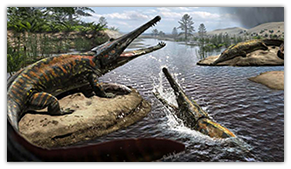 | | Australerpeton cosgriffi
Temnospondyl
"amphibian" collected from Permian rocks (c. 250 My) in the Serra do
Cadeado area (Paraná, Brazil). Discovered during the eighties by
researchers of Universidade Federal do Rio Grande do Sul, it has been
reaccessed by Estevan Eltink, Max Langer and co-workers. It was a large
aquatic predator of about 2 m in length.
|
| | |
 | | Bairdemys thalassica
Pleurodiran
turtle collected from miocenic rocks (c. 12 My) from
the Falcón state, Venezuela. The finding allowed a review of the
group and the proposition of a hypothesis that those turtles were
part of a marine radiation of side-neck turtles, specialized in hard
prey predation, such as crustaceans and molluscs. The new species was
described in 2015 by Gabriel Ferreira, Max Langer and
coleagues.
|
 | |
Batrachomimus pastosbonensis
Paralligatoridae
crocodylian collected in 2012 by the PaleoLab team in Nova Iorque,
Maranhão. It comes from jurassic rocks (c. 150 My), and it is the only
knownn Jurassic tetrapod from Brasil. Batrachomimus was described in 2013 by Felipe Montefeltro, Max Langer and coleagues.
|
| | |
 | | Bentonyx sidensis
Rhynchosaur
"reptile" collected from Triassic rocks (c. 240 My) from the south
coast of Devon-UK. Discovered in 2005 by University of Bristol
researchers, it was redescribed by Max Langer, Felipe Montefeltro, and
co-workers in 2010. The generic name honors Michael Benton, "rhynchosaur
champion" and former supervisor of Max Langer.
|
| | |
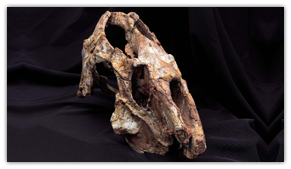 | | Brasinorhynchus mariantensis
Rhynchosaur
"reptile" collected from Middle Triassic rocks (c. 235 My) of Rio
Grande do Sul, Brazil. Discovered during the late eighties, it
remained for more than 25 years known as the "Mariante rhynchosaur" until it was described in 2016 by Cesar Schultz, Max Langer, and Felipe Montefeltro.
|
| | |
 | | Cambaremys langertoni
Fossil
turtle collected from Late Cretaceous rocks (c. 70 My) near Uberaba
(Minas Gerais, Brazil). Discovered during the nineties by researchers of
Centro de Pesquisasa Paleontológicas "Llewelin Ivor Price", it
was described by Marco França e Max Langer in 2005. It corresponds to a
Podocnemoidae, a turtle group currently known only in the Amazon and
Madagascar.
|
| | |
.png) | | Caiman and other cave fossils
Field-work during 2012 e 2013 recovered various Caiman fossils from inside Ioiô Cave, Diamantina Plateau, Bahia. Pleistocene in
age, they were collected along with fish, bird and mammal
(rodents, bats, carnivores and ungulates) fossils and described in 2014
by Mariela Castro, Felipe Montefeltro e Max langer.
|
| | |
 | | Candidodontidae
Candidodontidae
were small-bodied crocodyliforms previously known only in Africa and
northeastern Brazil. Felipe Montefeltro, Carolina Laurini, and Max
Langer described isolated teeth of these animals collected from Late
Crateceous rocks (c. 70 My) in São Paulo (southeastern Brazil),
extending their geographical range.
|
| | |
 | | Cearadactylus atrox
Pterosaur
(flying reptile) collected from Early Cretaceous rocks (c. 110 My) in
the Araripe Plateau (Ceará, Brazil). Originally described during the
eighties by Guiseppe Leonardi and Guido Borgomanero and
recently redescribed by Bruno Vila Nova and co-workers. It was a
medium sized, fish eating pterosaur.
|
| | |
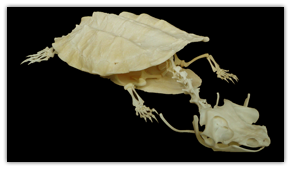 | | Chelus colombianus
Fossil
fresh-water turtle found in early Miocene (c. 20 Ma)
rocks of northwestern Venezuela. Originally described during
the eighties and reviwed by Gabriel Ferreira, Max Langer, and
co-workers in 2016. Image on the left shows the skeleton to the
amazonian Matamata, living representative of the genus.
|
| | |
.png) | | Clevosaurus brasiliensis
Sphenodontians
are a group of lepidosaurs represented today only by the New Zealand
Tuatara, but its fossil record is extencive, including Clevosaurus brasiliensis from
the Late Triassic of Rio Grande do Sul. This species was
redescribed in 2015, based on new specimens, by Annie
Hsiou and co-workers.
|
| | |
.png) | | Colombophis
Genus
of anilioid snake described in the 70ies by Robert Hoffstter and
Jean-Claude Rage, and revised during the Ph.D. of Annie Hsiou. It
includes two species, C. portai and C. spinosus, from the Miocene of Acre (Brazil), Colombia and Venezuela.
|
| | |
 | | Dasypus punctatus
Dasypus,
the armadillo know in Brazil as "tatu-galinha" had fossil relatives as
this Pleistocene (c. 10.000 years) species. Its better preserved
skeleton was collected during the seventies near Sorocaba (São Paulo,
Brazil). Originally described by Carlos de Paula Couto, it was
redescribed by Mariela Castro, Max Langer and co-workers.
|
| | |
| | Decuriasuchus quartacolonia
Rauisuchian
archosaur collected from Triassic rocks (c. 240 My) in the Quarta
Colônia area (Rio Grande do Sul, Brazil). Discovered in 2000 by
researchers of Fundação ZooBotânica do Rio Grande do Sul, and
described by Marco França, Max Langer and co-authors in 2011. Nine
skeletons were found together, suggesting a probable gregarious behavior.
|
| | |
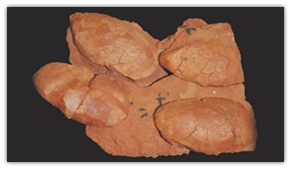 | | Fossil eggs
Fossil
eggs are more common that one might guess. Crocodile, turtle, and
avian eggs collected between 2008 and 2009 from Cretaceous rocks
(c. 80 My) of western São Paulo and the Triângulo Mineiro area (Minas
Gerais, Brazil) have been studied by Júlio Marsola, Felipe
Montefeltro, Max Langer, Annie Hsiou, and co-workers.
|
| | |
 | | Guaibasaurus candelariensis
Early
diverging saurischian dinosaur collected from Triassic rocks (c. 220
My) near Candelária and Faxinal do Soturno (Rio Grande do Sul, Brazil).
Discovered between 1998 and 2003 by the Argentinean palaeontologist José
Bonaparte, and redescribed by Max Langer, Jonathas Bittencourt e
co-authors in 2011.
|
| | |
 | | Hybodontidae
Hybodontids
were medium-sized sharks of broad distribution during the Late
Paleozoic and Mesozoic. Teeth and spines of these animals were collected
from the Permian rocks (c. 250 My) of Serra do Cadeado area
(Paraná, Brazil) and studied by Carolina Laurini and Max Langer.
|
| | |
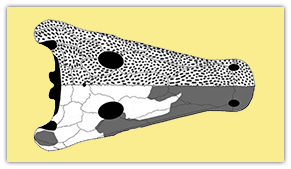 | | Konzhukovia sangabrielensis
Temnospondyl
"amphibian" collected from Permian (c. 255 Ma) rocks of Rio
Grande do Sul, Brazil. Described by the CAPPA/UFSM Palaeontology team,
with collaboration of Estevan Eltink. The genus Konzhukovia was
previously known from Russia, suggestion biotic interchange between
gondwanan and laurasian landmasses during the late Paleozoic.
|
| | |
 | | Lewisuchus admixtus
Dinosaur-line Archosaur
from the Triassic (c. 240 My) of Northwest Argentina. Collected in the
60's by a Harvard University team, it was recently revised by Jonathas
Bittencourt, Max Langer and coleagues. Lewisuchus admixtus was a small terrestrian predator with about 1 m length.
|
| | |
.png) | | Maxakalisaurus topai
Titanosaurid
sauropod from the Cretaceous (c. 75 My) of Minas Gerais,
Brasil, first described in 2006 by a team of Museu Nacional do Rio de
Janeiro. Further jaw specimens were described in 2016 by Júlio
Marsola, Max Langer, Annie Hsiou and coleagues from UNIVASF and UFU.
|
| | |
oto.png) | | Otozoum
Field
work between 2013 and 2014 by Simone D'Orazi Porchetti and
colleagues in outcrops of the Etjo Formation, in Namibia, led to the
description of the first Otozoum trackway from that Formation in
the Waterberg area. The presence of this ichnotaxon helps constraining
the age of this unit to the Lower Jurassic, and is the first of its kind
from Namibia.
|
| | |
 | | Pampadromaeus barberenai
Sauropodomorph
dinosaur collected from Triassic rocks (c. 230 My) near Agudo (Rio
Grande do Sul, Brazil). Discovered in 2005 by researchers of Universidade Luterana do Brasil and described by Max Langer, Jonathas Bittencourt, and co-authors in 2011. It was a small, about 1.5 m long, herbivorous animal.
|
| | |
 | | Pissarrachampsa sera
Baurusuchid
crocodyliform collected from Late Cretaceous rocks (c. 80 My) in the
Pontal do Triângulo area (Minas Gerais, Brazil). Discovered and
described by Felipe Montefeltro, Max Langer and co-workers between 2008
and 2011. It was a large predator, more terrestrial than modern
crocodiles.
|
| | |
| | Rhachiphyllum schenkii
First record of Callipteridae (Paltaspermales) "gymnosperms" in Brasil. It constrains the age of the Pedra de Fogo Formation to the Early Permian (c. 290 Ma). Collected during 2010, in Maranhão, by the PaleoLab team, and described in 2014 by Max Langer and co-workers.
|
| | |
 | | Sacisaurus agudoensis
Dinosauromorph
collected from Triassic rocks (c. 225 My) in the outskirts of Agudo
(Rio Grande do Sul, Brazil). Discovered in 2000 by researchers of Fundação ZooBotânica do Rio Grande do Sul,
it was described by Max Langer and co-authors in 2007. The generic name
refers to "saci" a mythological figure of Brazilian lore.
|
| | |
 | | Saturnalia tupiniquim
Sauropodomorph
dinosaur collected from Triassic rocks (c. 230 My) in the outskirts of
Santa Maria (Rio Grande do Sul, Brazil). The three known skeletons were
discovered in 1998 by researchers of the Pontifícia Universidade Católica do Rio Grande do Sul and
described by Max Langer and co-authors in various papers along 1999 e
2007. It was a small, about 1.5 m long, herbivorous animal.
|
| | |
| | Seismophis septentrionalis
The oldest known Brazilian snake, its vertebrae were collected by a team of Universiade Federal do Maranhão in Cretaceous (c. 100 Ma) rocks of the Cajual Island, São Marcos Bay, northern Maranhão, and described by Annie Hsiou and co-workers in 2013.
|
| | |
 | | Smilodon populator
The famous
South-American saber-tooted cat was broadly distributed in Brazilian
during the Pleistocene (c. 10.000 years). Its first record in São
Paulo corresponds to a skeleton collected by researchers of Museu de Zoologia (USP) and described by Mariela Castro and Max Langer.
|
| | |
 | | Staurikosaurus pricei
One of
the oldest known carnivorous dinosaurs; collected in 1934 from Triassic
rocks (c. 230 My) near Santa Maria (Rio Grande do Sul, Brazil) during a
join expedition of the Departamento Nacional de Produção Mineral (DNPM) and Harvard University, and redescribed by Jonathas Bittencourt and co-authorns in 2008.
|
| | |
 | | Tachiraptor admirabilis
Second non-avian dinosaur (first saurischian) found in Venezuela. Collected during 2012 by a team of the Instituto Venezolano de Investigaciones Científicas,
with help of the PaleoLab, from Early Jurassic (aprox. 200 Ma)
rocks of the Mérida Hills (northernmost part of the Andes).
Described by Max Langer and co-authorns in 2013.
|
| | |
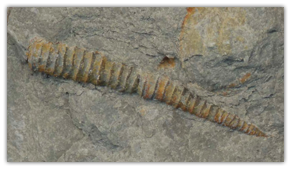 | | Tentaculitoidea
Grup
of marine metazoans of uncertain affinities (possibly related
to molluscs) with a broad Ordovician to Devonian record.
Brazilian fossils of Devoniano (aprox. 400 Ma) age, were reviewed in the
PhD thesis of Jeanninny Comniskey.
|
| | |
 | | Teyumbaita sulcognathus
Rhynchosaur
"reptile" collected from Triassic rocks (c. 230 My) near Candelária
(Rio Grande do Sul, Brazil). Discovered during the eighties by
researchers of Universidade Federal do Rio Grande do Sul, and
described by Felipe Montefeltro, Max Langer and co-author in 2011. The
genus name means "parrot-lizard" in the indigenous Tupi language.
|











